


Affiliate & review disclosure: UPLIFT Desk sent me the Clarksville Ergonomic Drafting Chair reviewed here (Black, standard configuration) as a free review unit. I did not pay for it, and that did not influence my findings: all opinions are my own. Some links are affiliate links; if you purchase through them, we may earn a small commission at no extra cost to you.
Our front reception has a sliding glass window, the kind you see at a doctor's or dentist's office. For years, whoever sat at the desk behind it looked up at clients from below the window. Once we raised the desk and put this chair behind it, our receptionist started meeting clients at eye level, and she appreciates the difference. The UPLIFT Clarksville Ergonomic Drafting Chair has been in use at that desk for about three weeks, mostly by reception staff who want the desk up high without having to stand.
- About three weeks of daily use at a reception desk set to 35 inches
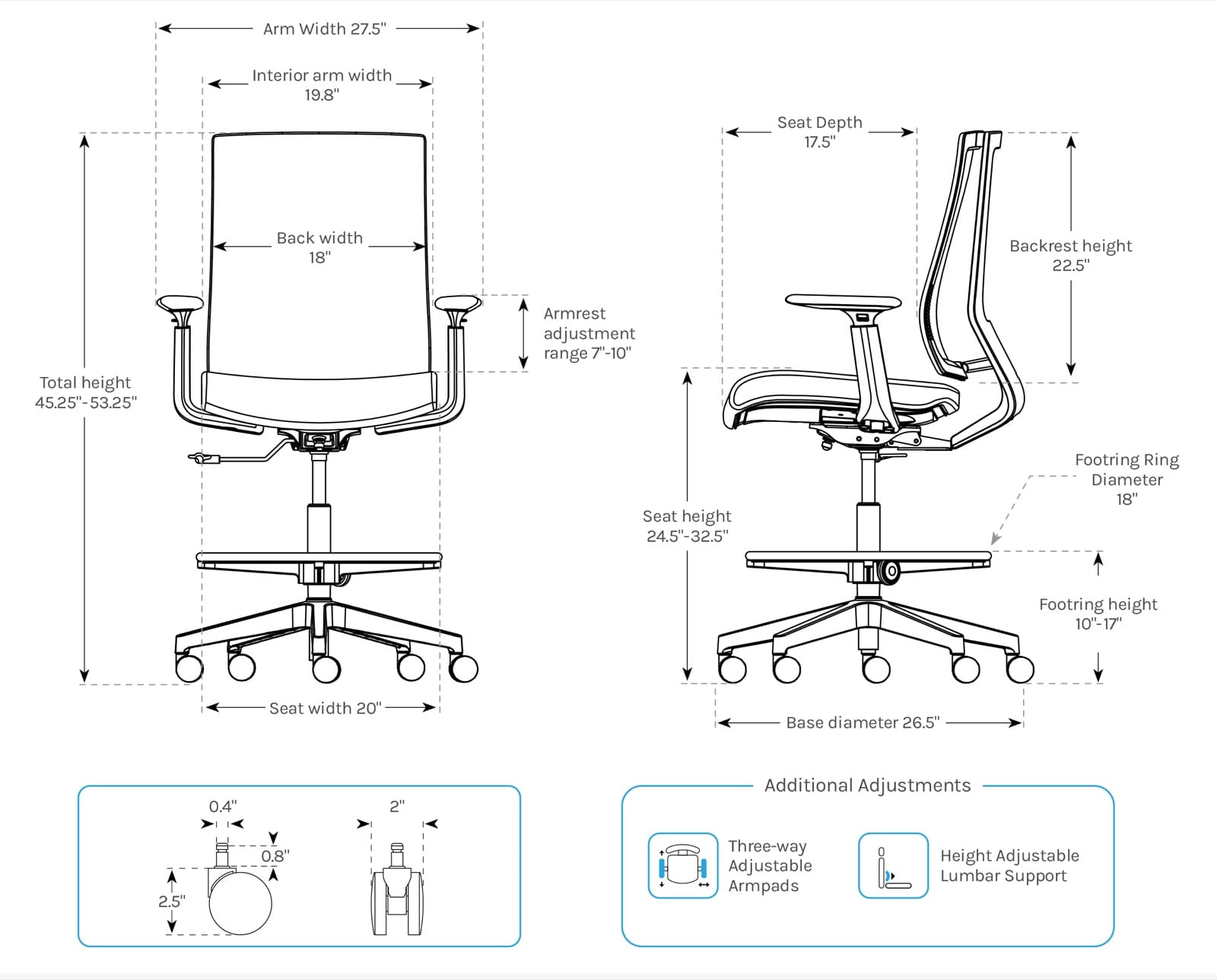
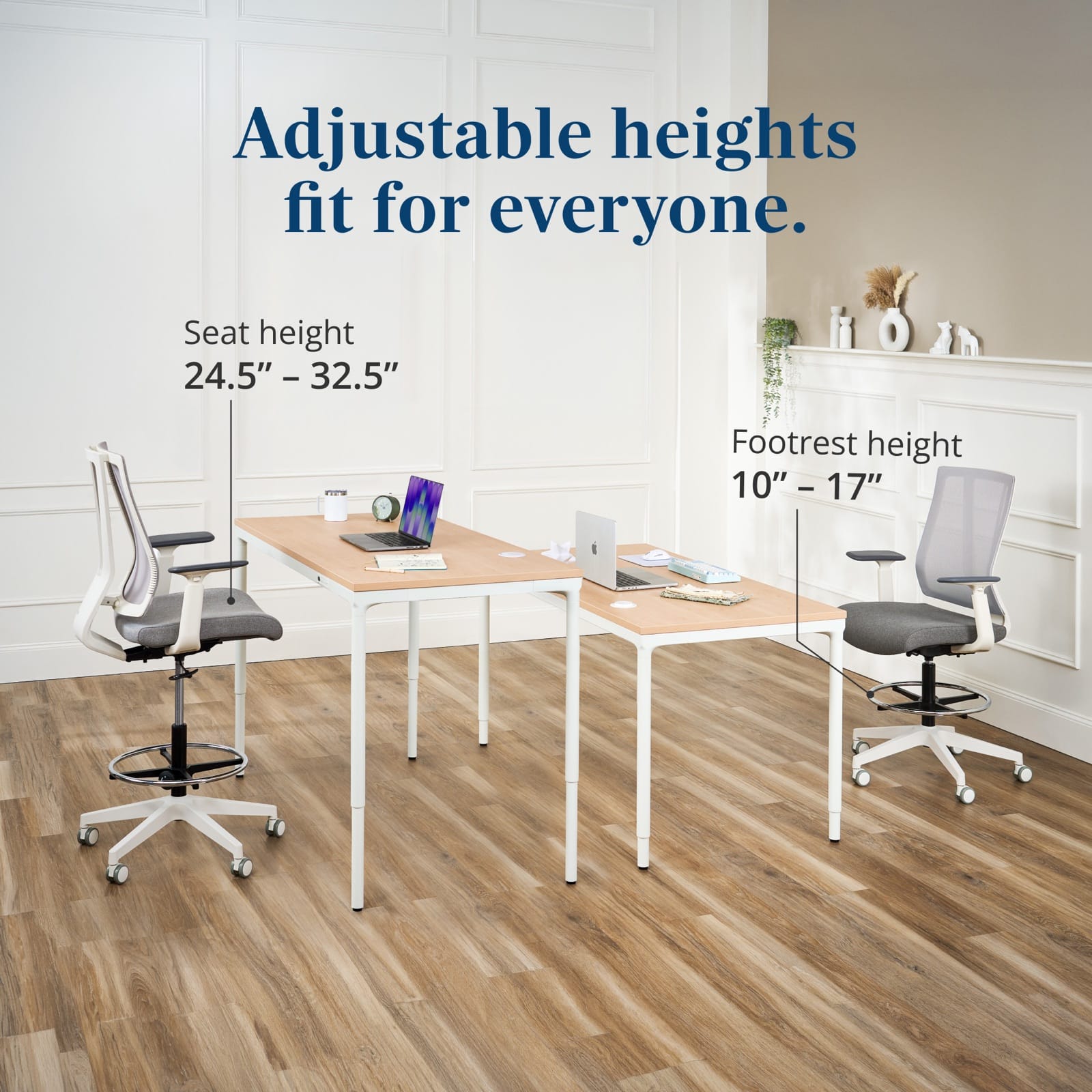
- Seat adjusts from 24.5 to 32.5 inches, with a separate foot ring from 10 to 17 inches
- Solid, quiet, and stable at full height, and easy to share between people of different heights
- Main gripe: the foot ring sits a little too far back for a natural footrest
Why a drafting chair at a standing desk
Until recently, our reception area had a standard stationary office desk and a regular office chair. A drafting chair was never on the table, because that desk did not move. What changed was the desk: reception now runs on an UPLIFT V3 L-Shape standing desk, which I cover in my UPLIFT V3 L-Shape desk review. Once the desk could go up, a taller chair finally made sense.
A standard office chair runs out of height long before a standing desk does. UPLIFT's own standard Clarksville tops out at a 22 inch seat. UPLIFT lists the V3 desk's height range as 22.6 to 48.7 inches, and the casters on my reception desk add about 2.5 inches to that. A 22 inch seat cannot follow a desk raised to counter height, and that gap is the reason this chair exists. For the same desk platform in a home office, see my home-office UPLIFT V3 review.
We keep the reception desk at 35 inches, a counter height that lines staff up with the window. Our office tries to follow UPLIFT's 20-8-2 rule: in each half hour, about 20 minutes sitting, 8 minutes standing, and 2 minutes moving. Our days run 8 to 12 hours depending on the season, so the chair sees regular use in short sitting stretches while the desk stays at counter height. Nobody has to lower the desk to sit down.
Unboxing & assembly
A chair that ships in pieces is only as good as its manual, and this one is good.
The chair arrived in a single, well-packed box by FedEx, undamaged, on UPLIFT's free standard shipping. The only waste was the protective packing that keeps parts from scuffing or breaking in transit.
The manual runs nine steps. UPLIFT includes a 5 mm and a 6 mm Allen wrench. The casters press into the base, the cylinder drops in, and the foot ring slides over it. The seat mechanism, arms, back plate, and back then bolt on in order. The last step is to press the seat firmly onto the base and sit on it to lock it down. The instructions are clear, and the illustrations do most of the explaining. Nothing in the process was confusing.
From opening the box to a finished chair took me about 25 to 30 minutes, working alone. Step 8 recommends a second person to hold the back in place while you fasten it to the base. I managed that step solo, but a helper would make it easier.
If you would rather skip assembly, UPLIFT sells an assembly service for $49 per chair.
Seat height & foot ring
The height range is the reason to buy this chair.
The seat adjusts from 24.5 to 32.5 inches. Per the manual, a paddle on the right side of the seat does the work: pull it up while you lift yourself slightly to raise the chair, and pull it while seated to lower it. In practice the paddle is smooth and easy, and the gas lift has behaved at every height we have tried. The range covers most counter heights.
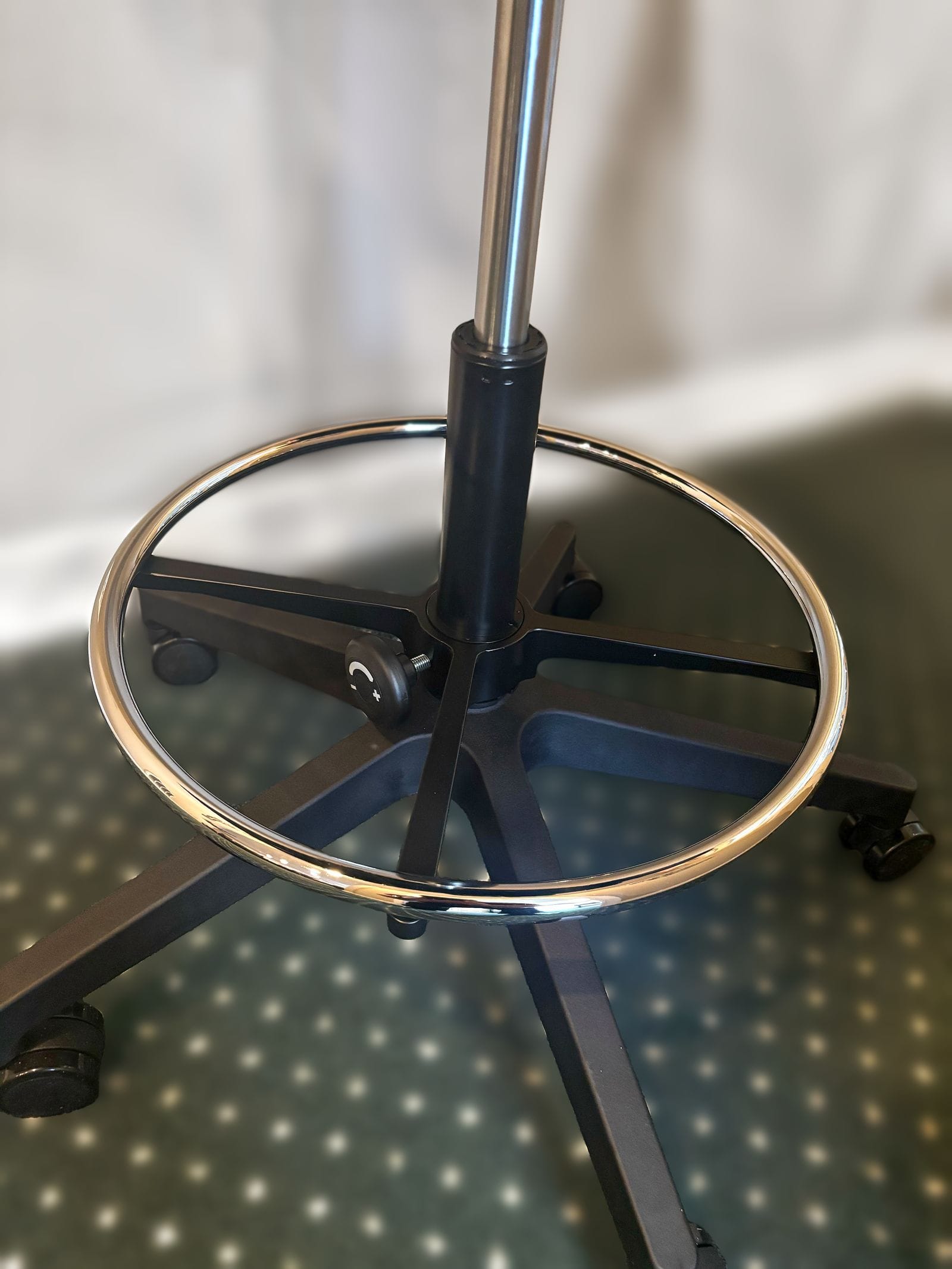
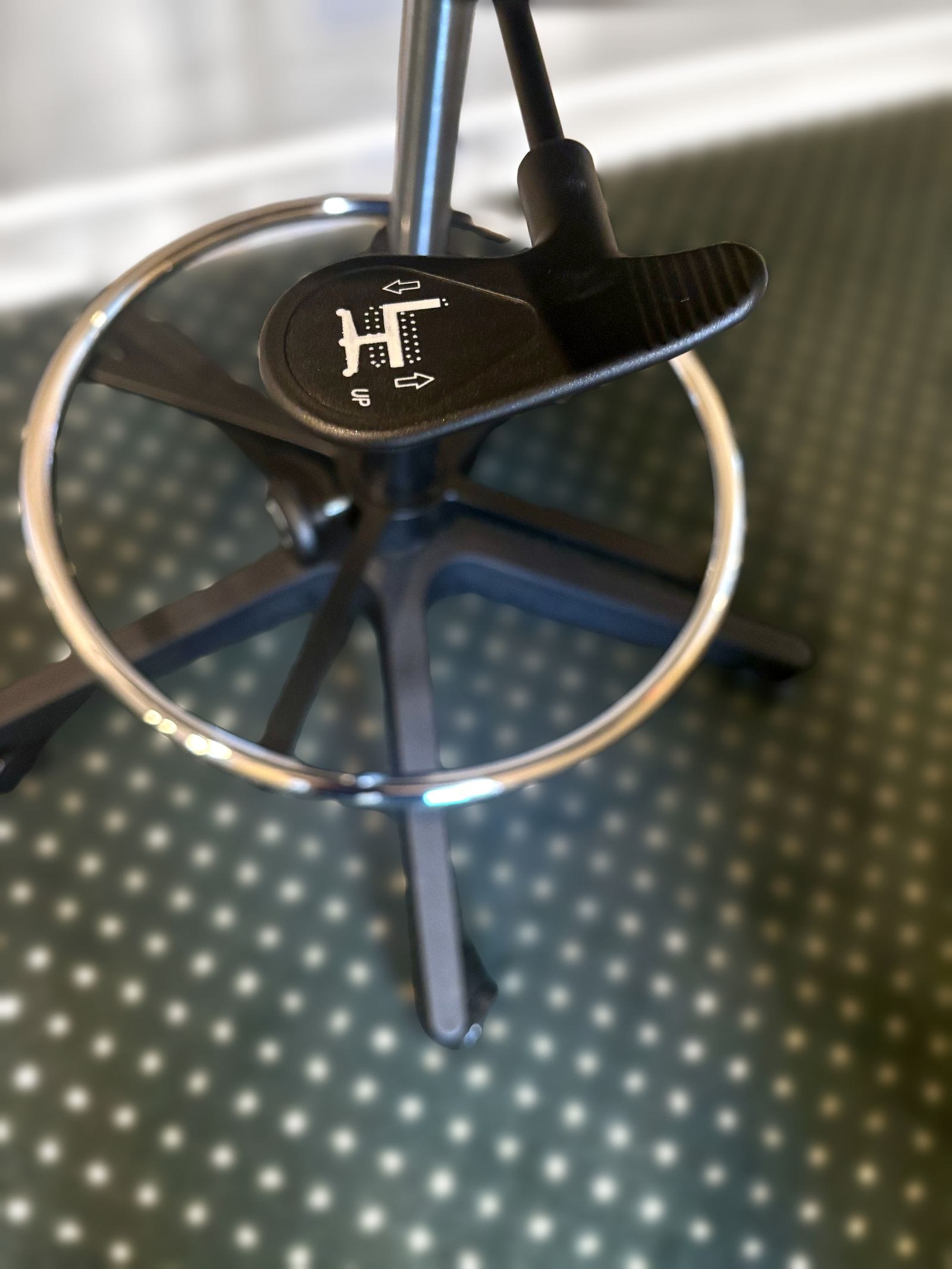
The foot ring is a separate adjustment. UPLIFT lists its range at 10 to 17 inches and its diameter at 18 inches. A rubber collar grips the cylinder, and a dial loosens the ring counterclockwise and clamps it clockwise. The dial is easy to work, the ring stays put once it is locked, and the collar has not slipped or scuffed the cylinder so far. With the desk at 35 inches, our ring lives around the lower third of its travel.
The ring is also what makes the chair easy to share. I am a little taller than our receptionist, so she raises the ring when she sits at the front desk and I lower it when I take a turn. That takes a few seconds, and nobody has to touch the desk.
The ring is a footrest and nothing else. UPLIFT's manual says not to stand on the seat or the ring.
Ergonomics & support
Many tall seats are stools. UPLIFT's own stool page calls them best for short-term sitting or perching because they lack lumbar support, and this chair is UPLIFT's answer to that.
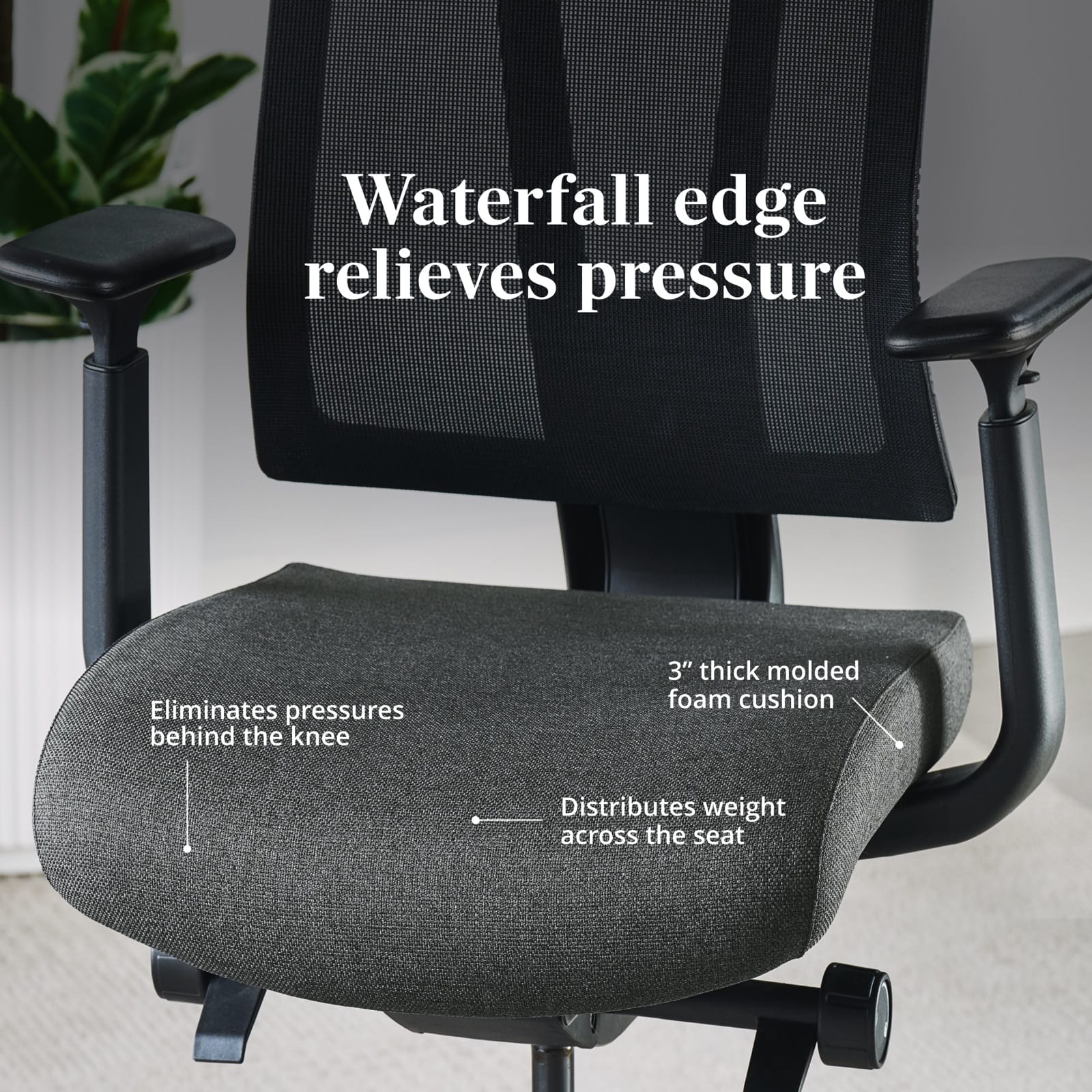
It is extremely comfortable, in the same way the UPLIFT Bolan Ergonomic Chair we use at our standard-height desks is. The seat is a 3 inch molded polyurethane foam cushion with a waterfall front edge, which UPLIFT says takes pressure off the backs of your legs. The cushion feels solid and stays comfortable through long stretches. Our receptionist's verdict is that the seat is wide and comfortable and does not press into the backs of her legs, even with the chair raised high. Seat depth is fixed at 17.5 inches.
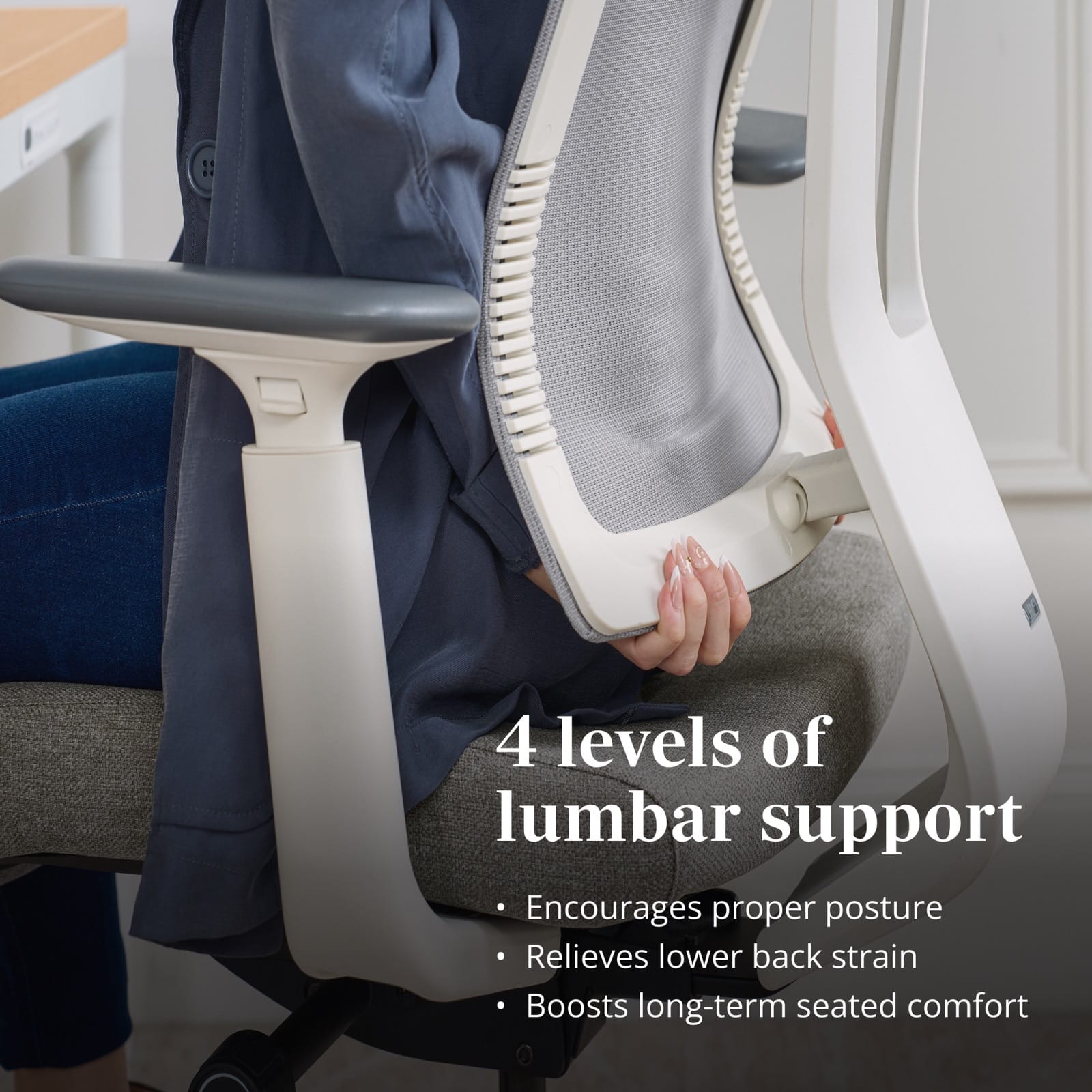
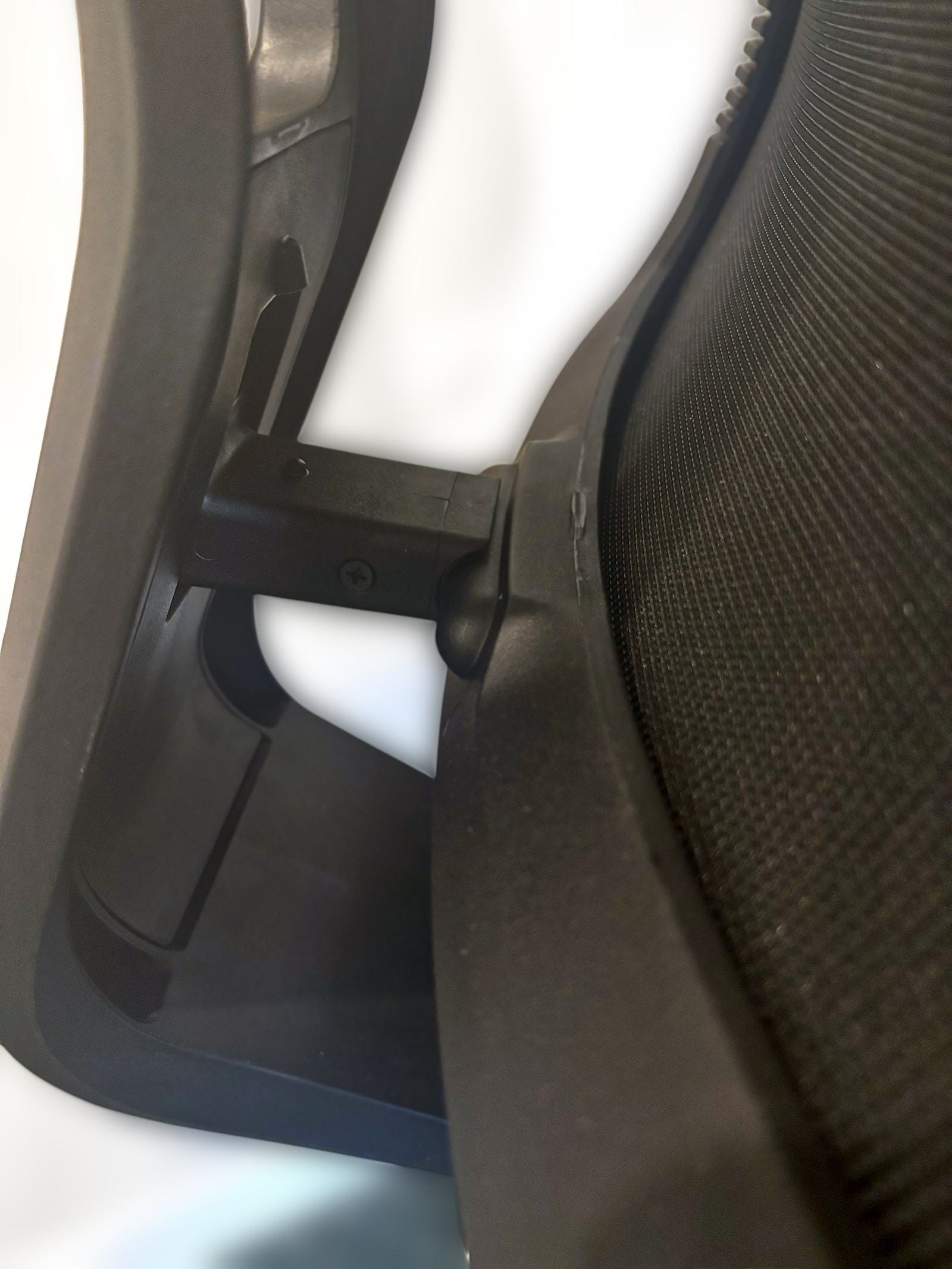
The backrest is very comfortable and supportive, especially at the higher seat heights. The lumbar support is concealed in the back and moves through four height positions. The manual says to lift the bottom edge of the back until it clicks into place; to start over, lift past the highest setting and let it drop. It is easy enough that we change it often, depending on who is at the reception desk. The back itself is woven nylon mesh on a contoured frame.
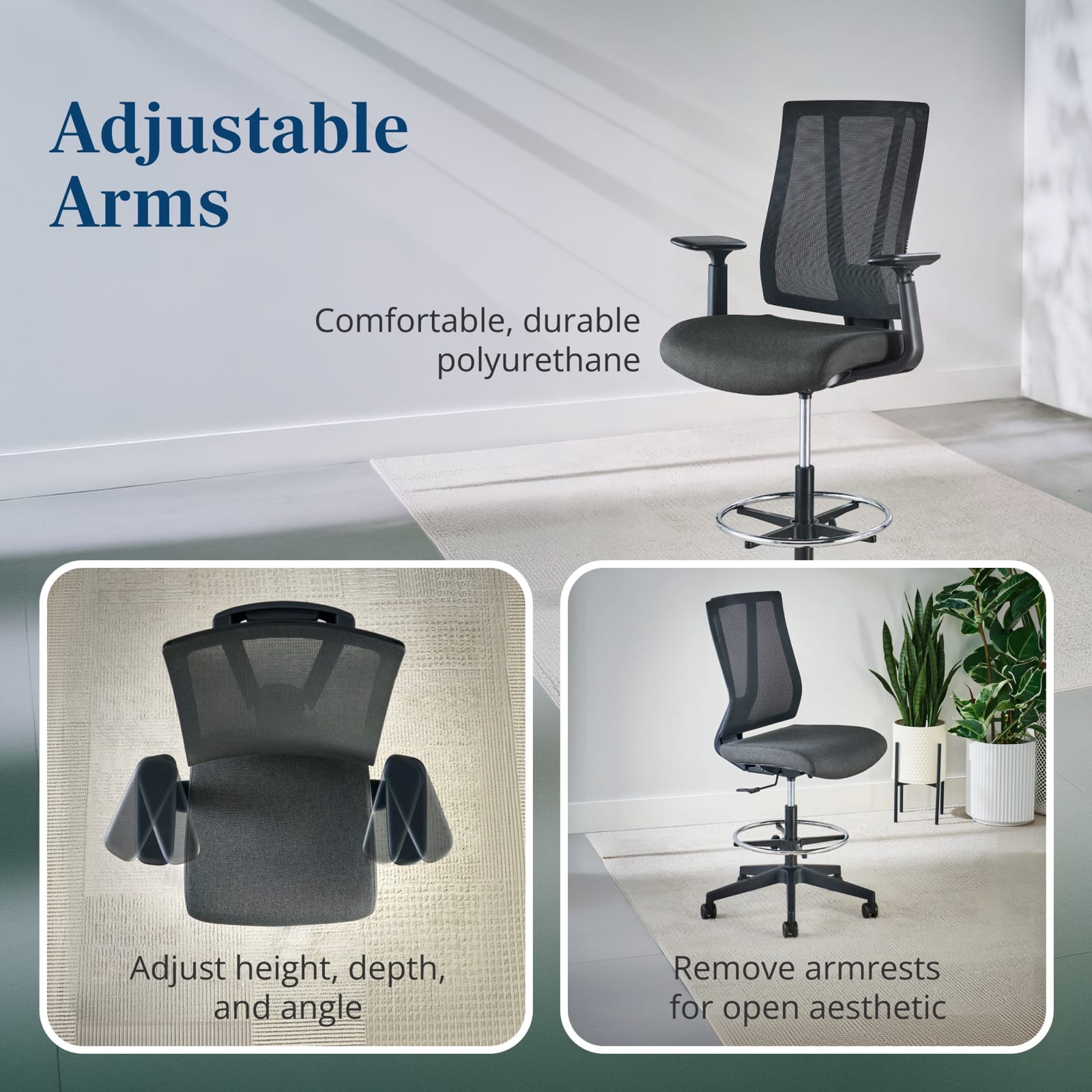
The arms adjust three ways: height, depth, and pivot angle, so they slide forward or swing outward to suit the sitter. They can also come off entirely. At the desk, the arms would only bump the desktop if they were set to the exact same height as the surface, and ergonomically they usually are not, so in daily use they clear it.
There is no recline and no tilt lock. On its product page, UPLIFT says the drafting chair stays upright and fixed, a safety choice inherent in drafting chairs that keeps sitters from leaning back far enough to tip over. The manual adds that it is not meant for significantly reclined positions. For counter work that has suited us fine: the chair stays upright, and the only regular tweak is the lumbar height.
Build & durability
A chair that holds you at counter height has less margin for a weak build, so the materials matter more here than on a regular desk chair.
After three weeks, there are no squeaks, no wobble, and no loose parts. Like the UPLIFT desk it sits at, it is among the most solid pieces of seating our office has owned. It is stable and not tippy, even at its maximum height. The casters glide well on both carpet and hard floors, and the chair swivels easily between both sides of the L-shaped desk and away from it when staff step out of the reception area.
UPLIFT specs the fabric and the mesh at 50,000+ Martindale abrasion cycles and describes the materials as contract grade. The base is a five-spoke molded nylon design, 26.5 inches across. UPLIFT says the chair meets ANSI/BIFMA X5.1-2017 for safety, durability, and structural performance, and that it meets GSA procurement requirements for government offices, schools, and contract buyers. UPLIFT's messaging goes further and says the chair was re-engineered on a more stable mechanism to exceed that standard. The product page says "meets," and that is the wording I am holding it to.
UPLIFT rates the chair for users up to 300 lb, a figure its product team confirmed to me directly.
The five casters roll freely and do not lock. UPLIFT says that is standard for most office and drafting chairs.
Design & finishes
A reception desk is the first thing clients see, so the chair has to look like it belongs there.
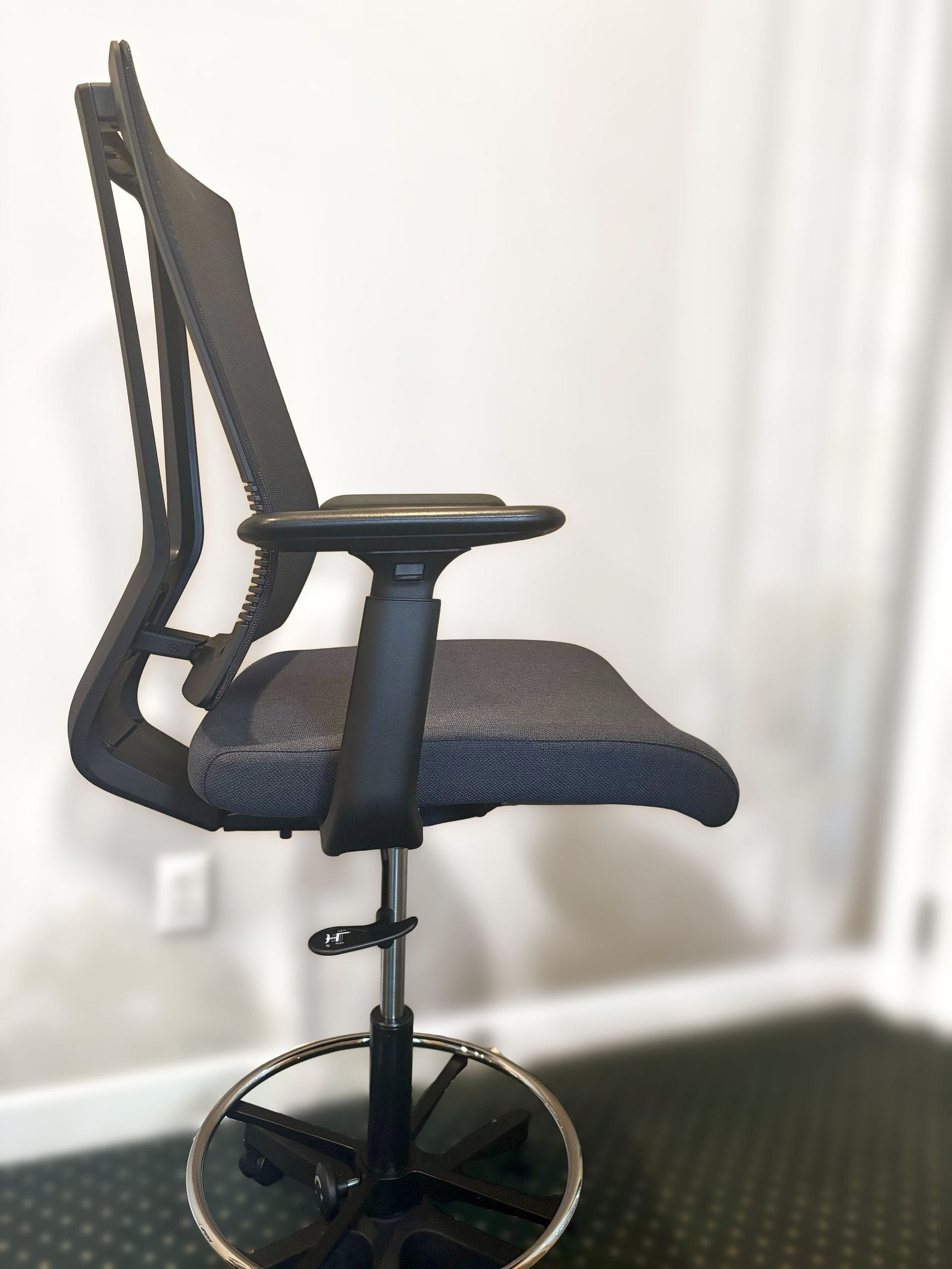
The chair comes in two finishes: all black, or Fog with gray fabric and a white frame and base. Ours is the Black finish. It looks professional at a client-facing desk, and the fabric has held up well to normal office wear so far. The concealed lumbar gives the back an uncluttered look, with no pad sticking out, which UPLIFT describes as a refined, low-clutter silhouette. The desk here is a walnut top on a black frame.
How it compares
The obvious question is why not buy the standard chair. UPLIFT says the two share the same ergonomic basics, because the drafting chair started as its most popular chair. The difference is height, and what you give up to get it. This is the first raised workstation our office has had, so I cannot compare it head to head with other drafting chairs. The comparison below is against UPLIFT's own lineup, from UPLIFT's published specs.
| Feature | Drafting Chair (CHR477) | Standard Clarksville (CHR475) |
|---|---|---|
| Seat height | 24.5 to 32.5 in | 17 to 22 in |
| Seat depth | Fixed at 17.5 in | Adjustable, 17.3 to 20 in |
| Recline | None | 40 degree mesh back recline, 3 tension levels |
| Lumbar | Concealed, 4 positions | Frame-integrated adaptive lumbar, 4 positions |
| Headrest | Not available | Optional, +$49 |
| Seat width and foam | 20 in, 3 in molded foam | 20 in, 3 in molded foam |
| Price (October 2026) | $399, Fog +$29 | $399, Fog +$30 |
If your desk stays at seated height, the standard Clarksville Ergonomic Chair is the better match, and UPLIFT's own page agrees. Our other desks sit at standard height, and there we use the UPLIFT Bolan Ergonomic Chair, so we have no need for a second drafting chair. The drafting chair makes sense when the work surface is standing height or higher.
UPLIFT's own stools start at $109 at the time of writing. UPLIFT describes its stools as best for short-term sitting or perching because they lack lumbar support, and the drafting chair adds lumbar support, a mesh back, and arms at that height.
Who it's for & who should skip it
The chair suits anyone with a counter or a raised standing desk who wants to keep the surface high and still sit for part of the day.
Good fit for
- Standing desks, drafting tables, and counters where you want to sit without lowering the surface
- Reception desks, retail counters, and other counter-height workstations
- Shared desks, since the foot ring and lumbar adjust in seconds between sitters
- Anyone who wants lumbar support and arms at counter height, not a perch
Better to skip it if
- You mostly sit at a standard desk height. UPLIFT recommends the standard Clarksville Ergonomic Chair for that, and our Best Office Chairs 2026 roundup has more seated-height options
- Your home office desk stays low. It only fits a home office with a standing desk or drafting table kept at a higher height
- You are on the shorter side. Very short sitters may not find it comfortable, so check the seat and foot ring ranges against your desk first
- You have a larger frame. Compare the 20 inch seat width, the armrest spacing, and the weight rating before you buy
- You want to lean back. There is no recline or tilt lock
What I liked
- Puts staff at eye level with clients at a raised reception window
- Comfortable, solid cushion and a supportive back, even at the higher seat heights
- Easy to share: the foot ring and lumbar adjust in seconds
- Stable at full height, with smooth casters on carpet and hard floors
- No squeaks, wobble, or loose parts after three weeks
- About 25 to 30 minutes to assemble alone, with clear illustrated instructions
- 15-year warranty and 30-day free returns
A few caveats
- The foot ring sits slightly back, so you tuck your feet onto it instead of resting them naturally
- You supply your own Phillips screwdriver
- No recline or tilt lock (by design)
- Fixed 17.5 inch seat depth
- Casters roll freely and do not lock
Full specs at a glance
| Specification | UPLIFT Clarksville Drafting Chair details |
|---|---|
| Product | Clarksville Ergonomic Drafting Chair by UPLIFT Desk, SKU CHR477 |
| Seat height | 24.5 to 32.5 in |
| Seat size | 20 in wide, 17.5 in deep (depth is fixed) |
| Back size | 18 in wide, 22.5 in tall, woven nylon mesh |
| Foot ring | Independent, 10 to 17 in height range, 18 in diameter, rubber collar, locking dial |
| Overall size | 27.5 in wide, 26.5 in deep, 45.25 to 53.25 in tall |
| Base | 5-spoke molded nylon, 26.5 in diameter |
| Weight | 39.3 lb |
| Weight capacity | 300 lb |
| Lumbar | Concealed, 4 height positions |
| Seat cushion | 3 in molded polyurethane foam, waterfall front edge |
| Arms | Three-way (height, depth, pivot); removable |
| Recline | None; fixed upright |
| Casters | 5, roll freely, do not lock |
| Abrasion resistance | Fabric and mesh: 50,000+ Martindale cycles |
| Standards | Meets ANSI/BIFMA X5.1-2017; GSA compliant |
| Colors | Black (black fabric, frame, base); Fog +$29 (gray fabric, white frame and base) |
| Assembly | 9 steps; 5 mm and 6 mm Allen wrenches included; Phillips screwdriver not included; UPLIFT assembly service $49 |
| Warranty | 15-year warranty |
| Price | $399 in Black as of October 2026 |
Price, warranty, returns & shipping
As of October 2026, the chair is $399 in Black on upliftdesk.com, and the Fog finish adds $29. The unit we tested is the Black, standard configuration. The standard Clarksville costs the same $399 in Black. UPLIFT also lists quantity pricing for offices buying four or more, but its return policy excludes any part of an order that includes four or more of the same item.
For what it delivers, I think it is worth the $399. The quality is the reason, and it has become the go-to chair at our reception desk.
UPLIFT backs it with a 15-year warranty. The company reduces the term proportionally for use beyond 40 hours a week, and the warranty covers the original purchaser only. Our office days run 8 to 12 hours depending on the season, and a shared front-desk chair can add up quickly, so the clause is worth reading for any office. The warranty excludes damage from improper assembly.
Returns run through UPLIFT's 30-day risk-free trial. Like-new products in their original packaging come back free, and UPLIFT covers return shipping from the contiguous United States. Orders ship free to the 48 contiguous states, and UPLIFT ships the same business day when you order by 3:00 PM Central.
Prices and availability are subject to change. Prices, specs, warranty and return terms last verified October 24, 2026, per upliftdesk.com.
Is the Clarksville Drafting Chair worth $399?
If I were shopping for a drafting chair with this kind of height and stability, this is the one I would buy with my own money. The quality, the build, and UPLIFT's reputation make it my pick right now for counter-height seating.
Best for: counters, reception desks, standing-height desks, and drafting tables where you want to sit at the working surface.
The rest of the front desk is covered in my UPLIFT V3 L-Shape desk review, my UPLIFT Sequence Shelving review, and my UPLIFT 3-Drawer File Cabinet review. For desks, see our Best Standing Desks 2026 comparison, or browse our office equipment guides.
Frequently asked questions
Is the Clarksville Ergonomic Drafting Chair a good drafting chair for a standing desk?
It is built for that job. The seat adjusts from 24.5 to 32.5 inches, which UPLIFT says suits standing desks, drafting tables, and counter-height work surfaces. We use it at a reception desk set to 35 inches, and it has been comfortable and stable there. UPLIFT recommends pairing it with a height-adjustable desk so the fit can be set precisely.
Does this drafting chair come with a footrest?
Yes. An independently adjustable foot ring sits on the chair's cylinder and adjusts from 10 to 17 inches. The ring is 18 inches across, and a rubber collar grips the cylinder. A dial loosens it counterclockwise and clamps it clockwise, and in our use it stays where you lock it. The ring sits slightly back from the front of the seat, so you may find yourself tucking your feet onto it.
How long does the Clarksville Drafting Chair take to assemble?
About 25 to 30 minutes from box to finished chair in our case, done by one person. The manual recommends a helper for attaching the back. Every tool is included except a Phillips screwdriver.
Does it have lumbar support?
Yes. A concealed lumbar mechanism moves through four height positions inside the backrest. You adjust it by lifting the bottom edge of the back until it clicks into the position you want, so there is no protruding pad.
Does the drafting chair recline or have a tilt lock?
No. UPLIFT says the chair stays upright and fixed, a safety choice inherent in drafting chairs that stops sitters from leaning back far enough to tip over. The standard Clarksville Ergonomic Chair has a 40 degree mesh back recline.
Can I take the arms off the drafting chair?
Yes. The three-way arms adjust in height, depth, and pivot angle. You can skip installing them during assembly or remove them at any time for a simpler look.
Can I use it at a regular seated-height desk?
UPLIFT says it is not the ideal fit. A standard desk surface sits about 28 to 30 inches off the floor, and a standard-height chair is more comfortable there. For a seated-height desk, UPLIFT recommends the standard Clarksville Ergonomic Chair instead.
Related articles
Disclosure: UPLIFT Desk provided the chair in this review as a free review unit. Trusted Product Scout may earn a commission on purchases made through affiliate links on this page, at no extra cost to you. UPLIFT, UPLIFT Desk, and Clarksville are trademarks of their respective owner. Prices and details as of October 2026; check upliftdesk.com for current pricing.

Thomas Camp Jr.
Thomas is an Enrolled Agent and NTPI Fellow, and President of Tax Specialists of the Carolinas, Inc., a tax preparation and nonprofit compliance practice. He reviews the office equipment and software his own firm actually puts to work, including in spaces his clients see every day.


